Rule-Word-Rod-Eye
Dates
Contributors
Concept and curation
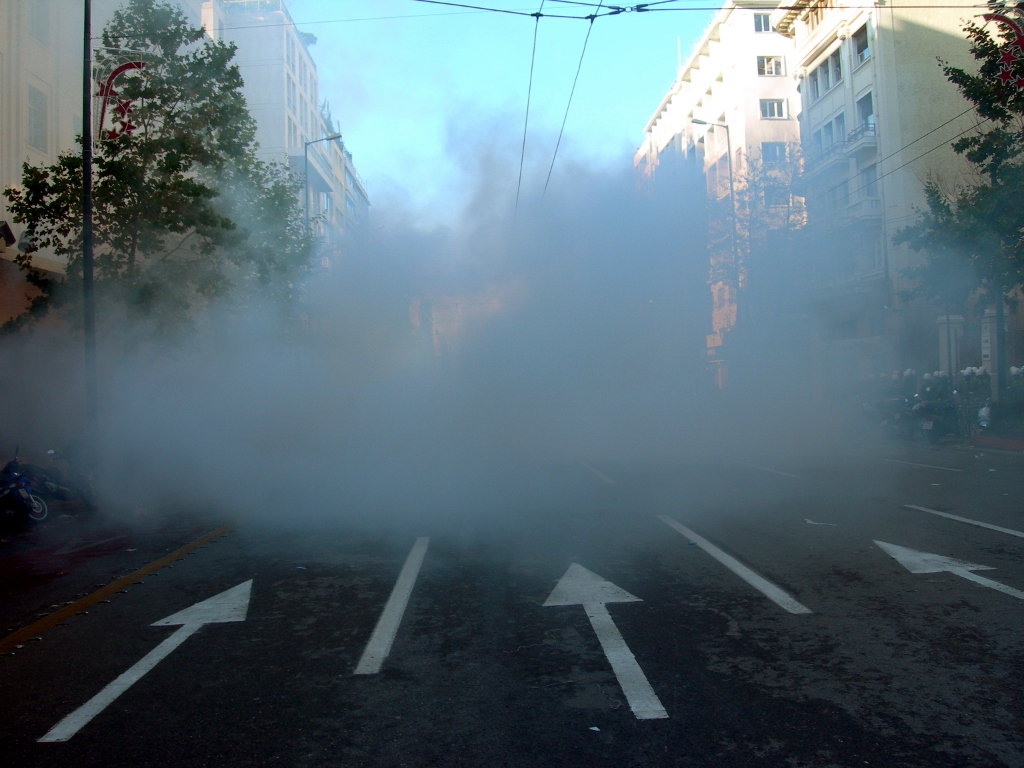
Public space does not merely constitute the surface of a social contract. Rather, it consists of ruptures, voids, and above all, the relationships that unfold within it.[1] Hannah Arendt identifies in these relationships the “capacity to act in concert,” which she identifies as “power.”[2] At the same time, public space is also characterised by a “thin sociality” — a form of coexistence that does not presuppose interaction, yet generates presence.[3]
Inextricably linked to the urban landscape — where “power” and “thin sociality” acquire form, rhythm, and materiality — public space oscillates between the imaginary and the enacted. What does it mean to be a citizen within such a fluid and constantly reshaped condition, especially in times of social and political turmoil?
Conceived by Panagiota Vagiou (b. 2000), a final-year law student with an interest in public space and international law, and Danae Parlamas Pertejo (b. 2001), a curator whose research interests focus on collective memory and modes of recording, the research and artistic project Rule-Word-Rod-Eye: Politics has returned to the streets explores the relationships between public space, the rule of law, documentation, and mnemonic tools through four discussions that bring together legal scholars, urban planners, architects, social scientists, and contemporary art practitioners.
Thursday, 20 November 2025, 19:30 | Discussion in Greek
We(,)the state: mutual shaping and mutual rupture
Speakers: Konstantinos Pittas (architect, writer, researcher in culture and public space, PhD, University of Cambridge), Vasiliki Makrygianni (architect, postdoctoral researcher, University of Bologna), Stefanos Levidis (architect, visual and spatial researcher, coordinator and co-founder of the Forensic Architecture Initiative Athens), Manos S. Eleftheroglou (Supreme Court lawyer, postdoctoral researcher in Administrative Law, lecturer at the Faculty of Law, National and Kapodistrian University of Athens).
Moderators: Danae Parlamas Pertejo, Panagiota Vagiou
What is public space and who has the right to it? How do institutional changes shape public space, and conversely, how do events unfolding within it demand institutional transformation? How is the experience of public space determined by one’s identity? How does one claim (a place in) public space?
Thursday, 27 November 2025, 19:30 | Discussion in Greek
Behind the lens and in front: between observation and presence
Speakers: Anastasia Tsoukala (Professor of Criminology with a focus on the design and implementation of internal security policies), Aggelos Barai (photojournalist & photographer), Athanasia Batziou (researcher and lecturer in visual communication, Imperial College London), Michailangelos Vlassis-Ziakas (artist).
Moderators: Danae Parlamas Pertejo, Panagiota Vagiou
Do acts of recording generate acts that demand to be recorded? Are acts that demand recording hindering the act of recording itself? How do these questions relate to the ways public order is enforced?
Tuesday, 2 December 2025, 19:30 | Discussion in Greek
Events as urban formation
Speakers: Amina Moskof (psychoanalyst), Dimitris Kechris (filmmaker, photographer, and PhD candidate in Film History and Theory at the Ionian University), Stavros Stavrides (Professor Emeritus at the School of Architecture, National Technical University of Athens)
Moderators: Danae Parlamas Pertejo, Panagiota Vagiou
How does the city remember and forget what has occurred —or imagine and represent what it has not (or cannot) remember? Can collective trauma function as a form of active urbanism? Are uprisings also an expression of collective mourning? When do urban clashes constitute acts of performance, and when performances of acts? And what is the significance of that distinction?
Thursday, 11 December 2025, 19:30 | Discussion in Greek
Territorial narratives: urbanism and the mapping of disputes
Speakers: Stavros–Nikiforos Spyrellis (researcher at the National Centre for Social Research (EKKE) specializing in social urban geography, co-editor of the Social Atlas of Athens), Georgia Sagri (Associate Professor at the Athens School of Fine Arts, artist), Rosa Vasilaki (academic sociologist-historian)
Moderators: Danae Parlamas Pertejo, Panagiota Vagiou
How do violence and policing shape the urban fabric? What constitutes the measurable and material field of public-space confrontations? Does the ground on which these occur matter? Is the barricade still relevant as a dual construction — both tangible and rhetorical?
The reexamination of public space, through the lens of the conditions that define our collective and personal relationship with the state in the streets, emerges as a critical imperative for Generation Z. For most of us, the unrests that marked Athens and other urban centers during the period of the financial crisis remain a blurred, abstract memory — composed of fragmented sounds, words, and images. Through processes of narration, collection, reflection, and dialogue, we aim to understand the events, mechanisms, and lived experiences that have shaped contemporary public space — so that we may, in turn, claim our share within it and imagine its possible futures.
[1] Filippidis, Christos. 2011. “The Polis-Jungle, Magical Densities, and the Survival Guide of the Enemy Within.” In Revolt and Crisis in Greece: Between a Present Yet to Pass and a Future Still to Come, edited by Antonis Vradis and Dimitris Dalakoglou, 72. Oakland, CA: AK Press.
[2] Arendt, Hannah. 1970. On Violence. New York: Harcourt, Brace & World, 45.
[3] Bodnar, Judit. 2015. “Reclaiming Public Space.” Urban Studies 52, no. 12: 2094.
Support
TAVROS Friends